
Article: Light Roast vs. Dark Roast: Which Has More Caffeine?

Light Roast vs. Dark Roast: Which Has More Caffeine?
It is one of the most common questions we hear at our market booth: "Which one has more caffeine, the light roast or the dark roast?" Most people expect the bold, dark cup to win. The real answer is more interesting, and it mostly comes down to how you measure your coffee and how you brew it.
The short answer
Gram for gram, light and dark roasts contain nearly the same amount of caffeine. If you measure with a scoop instead of a scale, a light roast usually gives you more caffeine. And how you brew makes a bigger difference than the roast itself.
Why measuring by the scoop changes the answer
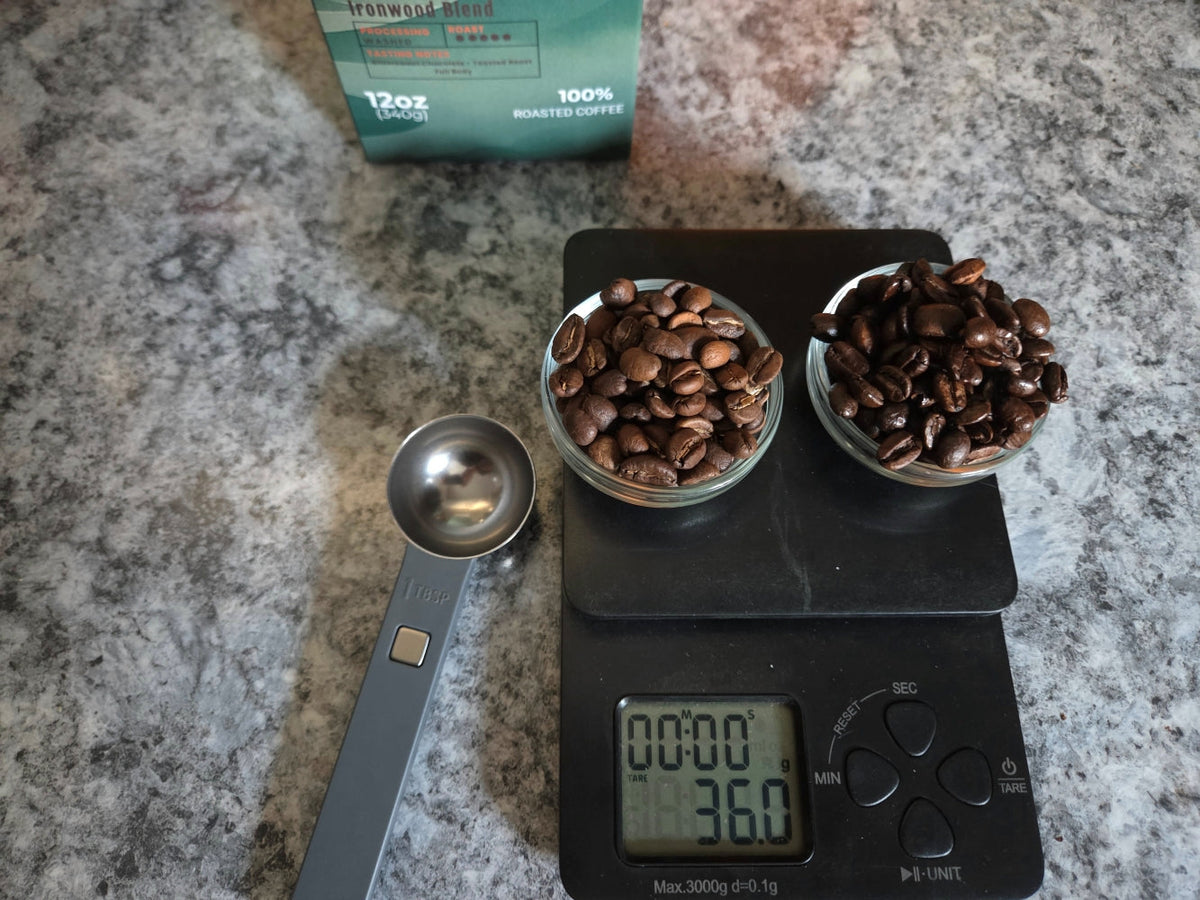
As coffee roasts, it loses mass, primarily water, and the beans expand. The longer the roast, the more pronounced that effect. Darker-roasted coffee therefore has a lower density than lighter-roasted coffee. As a result, a scoop of dark roast generally contains fewer grams of coffee than the same scoop of light roast.
America's Test Kitchen tested this directly. When they measured both roasts by the scoop, the light roast brewed with noticeably more caffeine. When they measured by weight instead, the two came out virtually the same.
What the research says about brewing
A 2024 study published in Scientific Reports by researchers at Berry College and Drexel University roasted the same coffees to five different levels and measured the caffeine in each brew. Under identical brewing conditions, dark roasts generally ended up with less caffeine in the cup than light and medium roasts. The reason is extraction: darker roasts released fewer dissolved compounds into the water overall. When the researchers compared roasts at the same extraction level, though, the dark roasts actually had slightly higher caffeine concentrations. Their takeaway was simple: brewing matters more than roasting.
The bigger factor: the kind of coffee
If you want to change your caffeine intake, the species of coffee matters far more than roast level. Robusta beans contain noticeably more caffeine than Arabica beans, a difference confirmed in a 2021 review of caffeine research published in the journal Foods. Most specialty coffee, including our Ironwood Blend, is made from Arabica.
How much caffeine is in a cup?
According to the U.S. Food and Drug Administration, a 12 ounce cup of coffee typically contains between 113 and 247 milligrams of caffeine. That wide range reflects everything above: the beans, the amount of coffee used, and the brewing method. For most adults, the FDA cites 400 milligrams a day as an amount not generally associated with negative effects. If you are pregnant, nursing, or have a health condition, the FDA recommends asking your health care provider whether you should limit caffeine.
So which roast should you choose?
Choose for flavor, not for caffeine. Light roasts tend to keep more of a coffee's bright, fruity, and floral character. Dark roasts lean toward chocolate, toasted notes, and a fuller body. If you want more consistent caffeine from cup to cup, measure your coffee with a scale and keep your brew strength consistent, whichever roast you love.
- Bright and lively: Sunrise Blend and Morning Bloom are both light roasts with fruit and floral notes.
- Bold and comforting: Ironwood Blend is a Brazilian Arabica dark roast with bittersweet chocolate and low acidity.
- All of the flavor, almost none of the caffeine: Quiet Earth Decaf is decaffeinated using the Swiss Water® Process.
Every bag is roasted fresh to order by our licensed roasting partner, so whichever roast you choose, it arrives at its peak.
Sources
- America's Test Kitchen: Caffeine Content of Coffee, Dark Roast vs. Light Roast
- Lindsey et al., "Caffeine content in filter coffee brews as a function of degree of roast and extraction yield," Scientific Reports (2024)
- Socha et al., "Influence of Various Factors on Caffeine Content in Coffee Brews," Foods (2021)
- U.S. FDA: Spilling the Beans, How Much Caffeine Is Too Much?